This joint paper by Reaching Critical Will and Article 36 explores the development of a legal framework for the prohibition and elimination of nuclear weapons.

Shop By
Women and Explosive Weapons
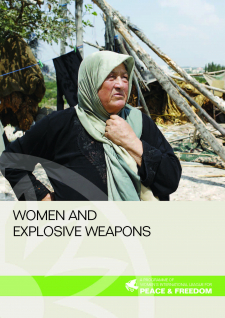
Concern with the use of explosive weapons in populated areas has increased over the last few years, due to the severe harm caused to civilians and the wider community. However, the debate has so far not sufficiently highlighted the specific impact that explosive weapons have on women.
Published in
2014
Assuring destruction forever: 2014 edition
This updated study explores the ongoing and planned nuclear weapon modernization programmes in China, France, India, Israel, Pakistan, Russian Federation, the United Kingdom, and the United States.
Published in
2014
A treaty banning nuclear weapons
An assessment of the PoA
This briefing paper, written by Daniel Mack of Instituto Sou da Paz, explores some of the key challenges facing the UN Programme of Action on small arms and light weapons and highlights opportunities and options for addressing small arms issues more effectively.
Published in
2014
First Committee briefing book 2014
Published ahead of the 2014 UN General Assembly First Committee, this briefing book highlights a number of current disarmament issues and suggests ways forward.
Published in
2014
Small arms, big picture
Ahead of the UN General Assembly First Committee, Reaching Critical Will and Instituto Sou da Paz have published a briefing paper examining the relationship between small arms and armed violence reduction.
Published in
2014
Banning nuclear weapons: an effective measure for disarmament
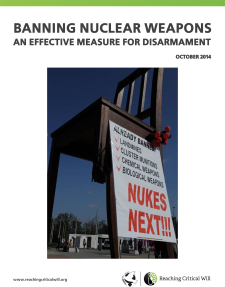
This paper explores the effective measures for nuclear disarmament presented by the New Agenda Coalition in its 2014 NPT working paper.
Published in
2014
Sex and drone strikes: gender and identity in targeting and casualty analysis
This paper from Reaching Critical Will and Article 36 addresses concerns that the sex of individuals is being used as a signifier to designate people as militants in drone strike targeting decisions and post-strike analysis of casualties.
Published in
2014
Filling the gap: report on the Vienna conference on the humanitarian impact of nuclear weapons
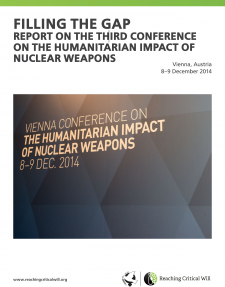
This publication is a conference report for the meeting hosted by the government of Austria on 8-9 December 2014 on the humanitarian impact of nuclear weapons.
Published in
2014
NPT Action Plan monitoring reports
At the 2010 NPT Review Conference, states parties adopted a 64 point action plan in order to further the implementation of the treaty. Reaching Critical Will, in partnership with the Government of Switzerland, has produced comprehensive reports on the implementation of this action plan from 2011 to 2015.
Published in
2015
Assuring destruction forever: 2015 edition
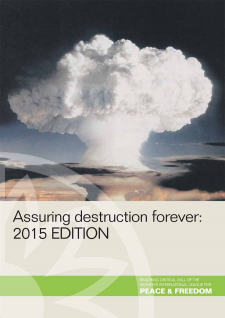
Published ahead of the 2015 UN General Assembly First Committee, this briefing book highlights a number of critical disarmament topics and suggests how governments can achieve progress.
Published in
2015
Filling the legal gap: the prohibition of nuclear weapons
This table overleaf from Reaching Critical Will and Article 36 summaries the gaps in existing treaty law related to nuclear weapons that could be filled by a treaty banning nuclear weapons.
Published in
2015
Gender-based violence and the Arms Trade Treaty
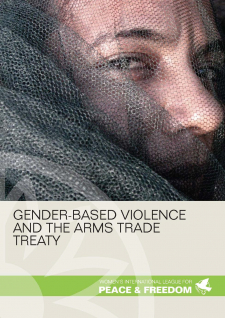
This briefing paper aims to provide some background on the terminology around GBV and to highlight questions that will be relevant for risk assessments under article 6 and 7 of the Arms Trade Treaty.
Published in
2015
First Committee briefing book 2015
Published ahead of the 2015 UN General Assembly First Committee, this briefing book highlights a number of critical disarmament topics and suggests how governments can achieve progress.
Published in
2015
Trading arms, bombing towns: the lethal connection between the international arms trade and the use of explosive weapons in populated areas
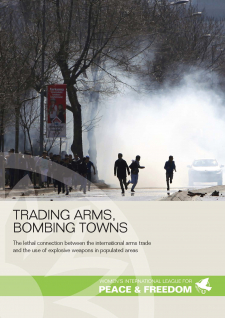
This briefing paper looks at the lethal connection between the international arms trade and the use of explosive weapons in populated areas and makes recommendations to governments and others on policy and practice.
Published in
2016
Women, weapons, and war: a gendered critique of multilateral instruments
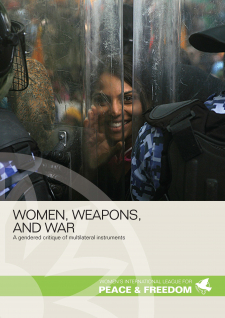
This publication considers synergies—and contradictions—related to gender and women in a number of multilateral resolutions, treaties, and commitments on conventional weapons and women's rights and participation.
Published in
2015
Preventing gender-based violence through arms control: tools and guidelines to implement the Arms Trade Treaty and UN Programme of Action
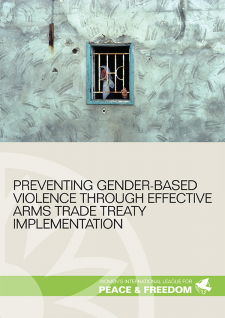
This report provides tools and guidelines for effective implementation of the Arms Trade Treaty and the UN Programme of Action on small arms and light weapons provisions related to gender-based violence.
Published in
2016
Explosive weapons and the right to health, education, and adequate housing
Together with WILPF's Human Rights programme, Reaching Critical Will prepared three briefs to the Committee on Economic, Social, and Cultural Rights on the transfer of weapons from France, Sweden, and the United Kingdom to Saudi Arabia and the use of explosive weapons in populated areas in Yemen.
Published in
2016
The Swedish arms trade and risk assessments: does a feminist foreign policy make a difference?
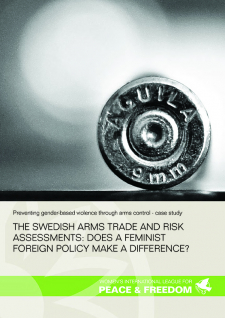
This publication is a case study associated with our report Preventing gender-based violence through arms control: tools and guidelines to implement the Arms Trade Treaty and UN Programme of Action.
Published in
2016
The Spanish arms trade and risk assessments
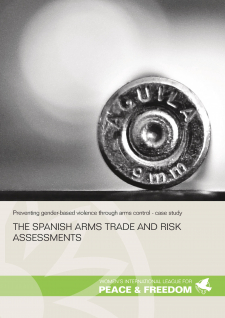
This publication is a case study associated with our report Preventing gender-based violence through arms control: tools and guidelines to implement the Arms Trade Treaty and UN Programme of Action.
Published in
2016
@2021- Reaching Critical Will - Women's International League for Peace and Freedom - Website Maintained by Tetra Information Services Pvt. Ltd.