Super User
First Committee briefing book 2021
Published ahead of the 2021 UN General Assembly First Committee, this briefing book highlights a number of critical disarmament topics and suggests how governments can achieve progress on them.
draft
The UN General Assembly and disarmament
The United Nations General Assembly is consensus-building body, where issues of international peace and security are collectively discussed among all UN member states.
Nuclear Weapons
WILPF has been demanding the elimination of nuclear weapons since the dawn of the nuclear age. As part of this effort, Reaching Critical Will worked with the International Campaign to Abolish Nuclear Weapons (ICAN) to achieve the Treaty on the Prohibition of Nuclear Weapons. We also monitor global nuclear weapon forums and treaty bodies and we are active in various local and national efforts for nuclear disarmament around the world.
Nuclear Weapons
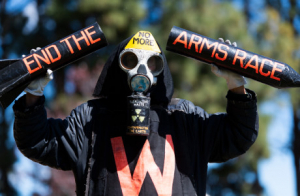
WILPF has been demanding the elimination of nuclear weapons since the dawn of the nuclear age. As part of this effort, Reaching Critical Will worked with the International Campaign to Abolish Nuclear Weapons (ICAN) to achieve the Treaty on the Prohibition of Nuclear Weapons. We also monitor global nuclear weapon forums and treaty bodies and we are active in various local and national efforts for nuclear disarmament around the world.
BANNING NUCLEAR WEAPONS
On 7 July 2017, 122 states voted in favour of a legally binding instrument banning nuclear weapons. Negotiated at a United Nations conference, the Treaty on the Prohibition of Nuclear Weapons makes the possession of these horrific weapons of mass destruction illegal, along with other related activities such as testing, using, developing, or assisting with nuclear weapons (which includes financing or planning to use the weapons, among other things). The treaty also includes provisions for assisting victims of nuclear weapons use and testing, and environmental remediation. It is the first treaty to recognise the disproportionate impact of nuclear weapons on indigenous people and on women.
Reaching this agreement is an amazing feat of collective action by people who came together to do something that had not been tried before. It is the result of decades of campaigning for the abolition of nuclear weapons by WILPF and other civil society organisations. Since 2007, WILPF has been part of the International Campaign to Abolish Nuclear Weapons (ICAN), which has worked with governments, international organisations, academics, and activists to bring this ban to fruition. We worked to generate a renewed focus on the humanitarian consequences of nuclear weapons, which opened space for consideration of the most appropriate political and legal responses to the existence of nuclear weapons.
As atomic bomb survivor Setsuko Thurlow said in her remarkable closing statement to the negotiating conference on 7 July, “This is the beginning of the end of nuclear weapons.” This treaty was conceived of as a tool that could help change the politics and economics of nuclear weapons as a means of facilitating disarmament. It provides a solid foundation to change policies and practices, as well as to shift the thinking and discourse on nuclear weapons even further.
Reaching Critical Will provided advocacy and daily analysis from the negotiations and has posted all relevant documents online. Check out some great videos from the conference on ICAN’s Vimeo page. You can also read RCW and ICAN’s writings at the Bulletin of Atomic Scientists, and view photos on //www.flickr.com/photos/30835738@N03/">ICAN’s Flickr page.
What's next? The TPNW entered into force on 22 January 2021, after the ratification of the 50th state party was secured in October 2020. WILPF will continue to work with ICAN to encourage more states to sign and ratify the Treaty, to ensure its full implementation, and to promote the Treaty within states that have so far boycotted this process.
HUMANITARIAN AND ENVIRONMENTAL IMPACTS OF NUCLEAR WEAPONS
WILPF has long raised concerns with the humanitarian and environmental catastrophe caused by nuclear weapons. We have been part of efforts in the United States, Australia, and elsewhere to collect and disseminate information about the effects of nuclear weapon production, testing, and use.
Reaching Critical Will participated in the series of conferences on the humanitarian impacts of nuclear weapons hosted by Norway (2013), Mexico (2014), and Austria (2014). We coordinated and edited a global study on this subject ahead of the first conference in Norway, and we have since then supported activist colleagues in disseminating further work, including on the gendered impacts of nuclear weapons.
NUCLEAR WEAPON MODERNISATION
All of the nuclear-armed states are currently engaged in programmes to "modernise" - upgrade or refurbish - their nuclear arsenals. This includes the bombs, delivery systems (like missiles, aircraft, and submarines), as well as related facilities used in the production of nuclear weapons. Since 2010, Reaching Critical Will has published an annual study that explores in-depth the nuclear weapon modernisation programmes of China, France, India, Israel, Pakistan, Russia, the United Kingdom, and the United States, and analyses the costs of nuclear weapons in the context of the economic crisis, austerity measures, and rising challenges in meeting human and environmental needs. The chapters are written by country experts with detailed knowledge of the programmes and their costs.
Model Nuclear Inventory 2005
The Model Nuclear Inventory is a comprehensive database of all nuclear materials, both military and civilian, in the 44 States recognized as having a significant nuclear capability.
Nuclear Disorder or Cooperative Security?
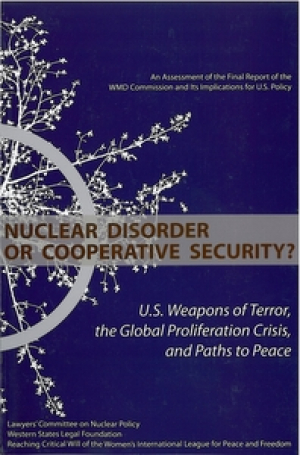
A civil society analysis of the current disarmament regime and response to the WMD Commission Report, released in May 2007 by the Lawyers' Committee on Nuclear Policy, Western States Legal Foundation, and Reaching Critical Will of WILPF.
Beyond arms control: challenges and choices for nuclear disarmament
Beyond arms control is a collaborative work of non-governmental researchers and activists who critically examine the mainstream discourse of nuclear weapons.
Costs, risks, and myths of nuclear power
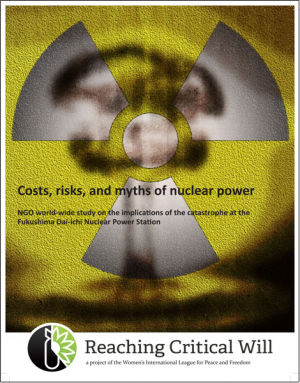
On 11 September 2011, six months after the disaster at the Fukushima Dai-ichi Nuclear Power Station in Japan, Reaching Critical Will released an NGO world-wide study on the implications of the catastrophe.
Assuring destruction forever: nuclear weapon modernization around the world
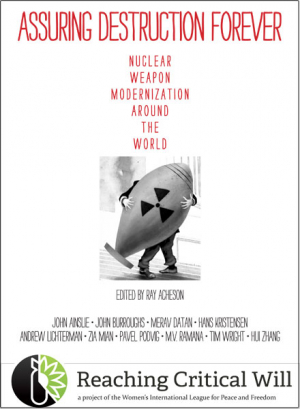
This updated study explores the ongoing and planned nuclear weapon modernization programmes in China, France, India, Israel, Pakistan, Russian Federation, the United Kingdom, and the United States.
The CTBT: obstacles to entry into force
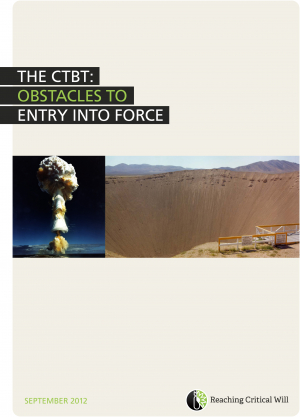
Today, more than 16 years after the Comprehensive Nuclear Test Ban Treaty (CTBT) was adopted, significant obstacles remain on the path to its entry into force.