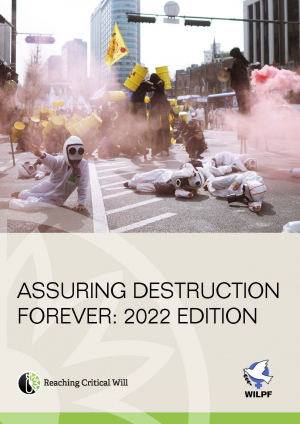
This updated study explores the ongoing and planned nuclear weapon modernisation programmes in China, the Democratic People's Republic of Korea, France, India, Israel, Pakistan, Russian Federation, the United Kingdom, and the United States.

Displaying items by tag: Nuclear Weapons
Friday, 18 February 2022 08:59
Assuring destruction forever: 2022 edition
Friday, 18 February 2022 08:54
2022 NPT briefing book
Published in advance of the 2022 Non-Proliferation Treaty Review Conference, this briefing book provides an overview of critical issues and offers recommendations to governments for the Review Conference and beyond.
Published in
2022
Friday, 18 February 2022 08:46
First Committee briefing book 2021
Published ahead of the 2021 UN General Assembly First Committee, this briefing book highlights a number of critical disarmament topics and suggests how governments can achieve progress on them.
Published in
2021
Tagged under
Sunday, 06 February 2011 05:11
2010 NPT Review Conference Action Plan: the peaceful uses of nuclear energy
Published in
2010
Tagged under
Tuesday, 21 September 2021 11:26
Nuclear Weapons
WILPF has been demanding the elimination of nuclear weapons since the dawn of the nuclear age. As part of this effort, Reaching Critical Will worked with the International Campaign to Abolish Nuclear Weapons (ICAN) to achieve the Treaty on the Prohibition of Nuclear Weapons. We also monitor global nuclear weapon forums and treaty bodies and we are active in various local and national efforts for nuclear disarmament around the world.
Published in
Areas of Work
Tagged under
Thursday, 25 August 2005 07:20
Model Nuclear Inventory 2005
The Model Nuclear Inventory is a comprehensive database of all nuclear materials, both military and civilian, in the 44 States recognized as having a significant nuclear capability.
Published in
2005
Tagged under
Sunday, 25 August 2013 07:20
Nuclear Disorder or Cooperative Security?
A civil society analysis of the current disarmament regime and response to the WMD Commission Report, released in May 2007 by the Lawyers' Committee on Nuclear Policy, Western States Legal Foundation, and Reaching Critical Will of WILPF.
Published in
2013
Tagged under
Sunday, 25 August 2013 07:16
Beyond arms control: challenges and choices for nuclear disarmament

Beyond arms control is a collaborative work of non-governmental researchers and activists who critically examine the mainstream discourse of nuclear weapons.
Published in
2013
Tagged under
Sunday, 25 March 2012 07:06
Assuring destruction forever: nuclear weapon modernization around the world
This updated study explores the ongoing and planned nuclear weapon modernization programmes in China, France, India, Israel, Pakistan, Russian Federation, the United Kingdom, and the United States.
Published in
2012
Tagged under
Sunday, 25 August 2013 06:58
The CTBT: obstacles to entry into force
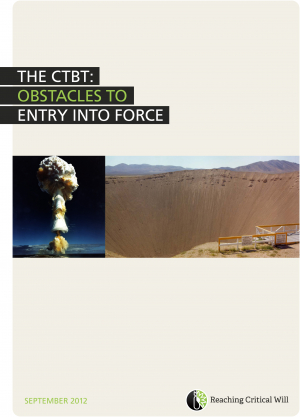
Today, more than 16 years after the Comprehensive Nuclear Test Ban Treaty (CTBT) was adopted, significant obstacles remain on the path to its entry into force.
Published in
2013
Tagged under
@2021- Reaching Critical Will - Women's International League for Peace and Freedom - Website Maintained by Tetra Information Services Pvt. Ltd.