3 November 2008 - Final Edition
Editorial: Crisis of Relevance
27 October 2008 - Third Edition
Editorial: Force of Logic
20 October 2008 - Second Edition
Editorial: Organizing for Disarmament
13 October 2008 - First Edition
Editorial: Bread not bombs—de-weaponising security
6 October 2008 - Preview
Editorial: Opportunities for the 2008 UNGA First Committee
4 November 2009 - Final Edition
Editorial: In pursuit of consensus
In his closing remarks, First Committee Chair Ambassador José Luis Cancela of Uruguay explained that since the Committee began working this year, delegations have listened to him say that his main aspiration was the greatest possible consensus between all delegations. He called for consensus not as minimal points in agreement to create formulations more or less repeated every year and not as an imposition of the powerful over the weak, but consensus as a cornerstone for building genuine efforts to push forth in this unprecedented moment for disarmament and non-proliferation.
Most delegations took this call seriously. Sponsors of several draft resolutions engaged in intensive consultations to garner consensus on their texts, which sometimes resulted in substantial modifications to the drafts in order to accommodate concerns of other delegations. Some of these resolutions included those on a fissile materials treaty, the Convention on Cluster Munitions, transparency and confidence-building measures in outer space, the International Day against Nuclear Testing, and perhaps most notably, the arms trade treaty. Not all of these efforts were successful; the final example had to be adopted by a recorded vote.
Regardless of their success, these efforts demonstrate that consensus is not just an outcome but also a process. Consensus as a process is intended to be cooperative rather than competitive, to facilitate compromise rather than zero-sum approaches, and to ensure that the “tyranny of the majority” cannot silence the concerns of a minority.
Consensus as an outcome offers an aura of unity. It suggests that the final product is satisfactory to all participants, which will make its implementation easier, because everyone involved agrees with it. Yet with some resolutions, it is not at all clear that consensus demonstrates unity. Delegations frequently issued explanations of vote on resolutions adopted by consensus to register remaining concerns they feel were inadequately addressed in the modifications, or even to withdraw their participation from the consensus adoption altogether.
Some draft resolutions were so compromised in an effort to reach consensus that their original supporters had to issue explanations of vote. At least ten delegations that have been traditionally strong supporters of developing a robust and legally-binding arms trade treaty expressed concern with operative paragraph five (OP5) of the resolution, which mandates the treaty negotiating conference to be undertaken “on the basis of consensus”. Even with this concession that so alarmed some treaty supporters, the draft resolution was not adopted by consensus.
Why would governments that want a universal arms trade treaty be concerned about a negotiating conference undertaken on the basis of consensus? Do they object to equal respect for all delegations’ concerns and priorities? Do they not want a treaty that all governments will ratify and implement?
On the contrary, in their explanations of vote these ten delegations worried that consensus would mean delays or prevention of negotiation or adoption of the treaty; that it could reduce the quality of the outcome by leading to the adoption of the “lowest common denominator”—or to no outcome at all; and that it will undermine the credibility of the negotiating process and the treaty by giving all states a “veto”.
Are these concerns those of powerful countries seeking to impose their will on the less powerful? This is difficult to imagine, given that the world’s biggest arms producer and exporter—the United States—actually demanded the consensus mandate. Rather, the anxiety over OP5 reflects a much broader concern with the way consensus is currently treated in multilateral disarmament diplomacy.
At the Conference on Disarmament (CD), where no substantive work has occurred since 1998, the rules of procedure stipulate that the Conference “shall conduct its work and adopt its decisions by consensus.” This has led to a stalemate perpetuated by one delegation or another using the consensus rule as a veto to block the commencement of work. In effect, consensus as currently practiced in the CD avoids tyranny of the majority by empowering a tyranny of the minority.
Many delegations have grown frustrated with this situation. They suggest modifications to the CD’s rules of procedure. Others argue that the problem is not with the rules but with political will—or with the loss of the art of compromise. Some argue that the rule of consensus is necessary to protect national security interests.
This gets to to the real heart of problem, at least in the context of disarmament negotiating fora. The “national security interest” is put above all else, but without discussion on what—or whose—interests these are. The “national interest,” as it is typically invoked in this sense, does not refer to the well-being of the general population but of those managing the military-industrial complex. Their interests generally dominate discussions at disarmament fora and block the commencement of work or the adoption of treaties or outcome documents.
Most of the treaties or issues currently on the disarmament and arms control table are measures that would—if pursued in good faith through cooperation and compromise—actually serve to enhance true national security: the security of population and sovereignty, security against weapons and war.
Ambassador Cancela called for consensus as a cornerstone for building genuine efforts to push forth in this unprecedented moment for disarmament and non-proliferation. This effort will require, as Swiss Ambassador Streuli noted, “a fundamental revision” of thinking, “taking global security into account.”
In the time leading up to the next CD session and to the arms trade treaty negotiating conference, governments should think seriously about what consensus really means, both as a process and an outcome. Does it mean compromise? Does it mean tyranny? Or does it afford the opportunity to promote cooperative approaches to enhancing global security?
26 October 2009 - Third Edition
Editorial: Closing the gaps
19 October 2009 - Second Edition
Editorial: Getting from rhetoric to reality
12 October 2009 - First Edition
Editorial: The past, present, and future of nuclear weapons
The opening week of First Committee’s general debate has been once again a largely static affair. Though the tone has been much more positive than in recent years, with most delegations welcoming the “positive momentum” created by the renewed interest in establishing a nuclear weapon free world, little has been proposed in the manner of concrete action.
This trend did not go unrecognised. The Swiss representative, Mr. Anton Thalmann from the Ministry of Foreign Affairs, argued, “While words and good intentions are needed to create a positive atmosphere, they alone will not move the disarmament agenda forward. Real action is needed.” He provided several concrete examples of real action, including “lessening of the role of nuclear weapons in national doctrines” and “reduction of the alert levels of nuclear weapons”.
The Swiss were not the only ones to outline specific steps. Returning to what Bush-era diplomats dismissed as “laundry lists of traditional arms control steps,” US Under Secretary of State Tauscher cited reducing her country’s nuclear arsenal, ratifying the Comprehensive Test Ban Treaty, and negotiating a verifiable fissile materials cut-off treaty as necessary undertakings.
Welcoming this return to past commitments, it is important to note that indeed these steps are past commitments. As a few delegations pointed out during general debate, there appears to be a movement by some nuclear weapon states toward expanding the non-proliferation requirements beyond those stipulated in the nuclear Non-Proliferation Treaty while at the same time referencing only past commitments to disarmament without moving toward their implementation. UN Security Council resolution 1887, adopted on 24 September at the Council’s Summit on nuclear non-proliferation and disarmament, is case in point.
Actually implementing past commitments is essential to moving forward. Furthermore, it is imperative for the majority of UN member states and civil society that the nuclear non-proliferation and disarmament agendas advance together.
In an effort to encourage forward-looking debate on nuclear disarmament that leads to concrete steps toward abolition, Reaching Critical Will last week urged delegations to consider and discuss the humanitarian merits of nuclear weapons, removed from the rhetoric of military utility. Some have already begun to engage this topic.
Norway’s representative, Mr. Steffen Kongstad from the Ministry of Foreign Affairs, emphasised, “There can be no doubt that nuclear weapons are the most inhuman and indiscriminate weapons ever created. Nuclear disarmament and non-proliferation are essential from a humanitarian perspective.” He also argued, “advancement in the field of disarmament and arms control can only be achieved if states listen to, learn from and include strong voices from civil society that advocate change. Such advocates for change must include field-based organisations, women’s organisations and representatives of the people affected by the continued stalemate over these issues.”
Speaking out as an organisation that endeavours to prevent human suffering by promoting and strengthening humanitarian law and principles, the International Committee of the Red Cross addressed the issue of nuclear weapons for the first time in its statement to the First Committee. On behalf of the ICRC, Mr. Robert Young argued, “Nuclear weapons are unique in their destructive power, in the unspeakable human suffering they cause, in the impossibility of controlling their effects in space and time, in the risks of escalation and in the threat they pose to the environment, to future generations, indeed, to the survival of humanity.”
Every step on the non-proliferation and disarmament agenda must be geared toward ensuring the security and survival of humanity. As High Representative for Disarmament Affairs Sergio Duarte noted in a speech on 18 September 2009, the old rationale for nuclear weapons is neither practical nor realistic. He argued that nuclear deterrence cannot prevent the use of nuclear weapons, “as there are countless ways that such deterrence can break down—a danger that is only compounded by the expanding number of states that possess such weapons.” He also argued that pledges of no-first use are insufficient for avoiding the use of nuclear weapons, since such pledges “implicitly rationalize the second use of such weapons, even against cities.”
This demonstrates the need for a new discourse on nuclear disarmament. The Norwegian representative argued that important lessons can be learned from the Convention on Cluster Munitions and the Mine Ban Treaty, which “demonstrated that it is possible to make a real difference to human security by breaking old habits.” He cited “mobilising political will, working across traditional groups, and in partnership with survivors and relevant stakeholders” as imperative for these and other disarmament instruments.
Reaching Critical Will hopes more delegations will speak out about nuclear weapons and human security during the thematic debate on nuclear weapons this week. We look forward to hearing proposals this week that turn the positive atmosphere into positive action.
5 October 2009 - Preview

Editorial: Time to reframe the debate
More...
2 November 2010 - Final Edition
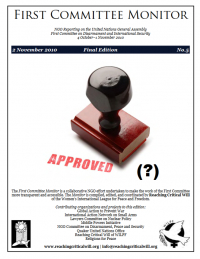
Editorial: Consensus versus progress?
25 October 2010 - Third Edition
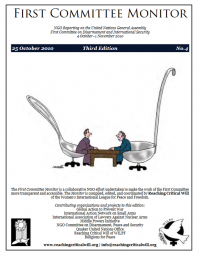
Editorial: A framework for what objectives?
18 October 2010 - Second Edition

Editorial: Impatient realism
11 October 2010 - First Edition
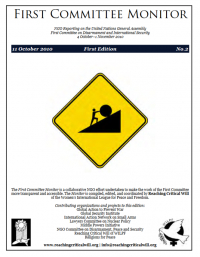
Editorial: Overarmed and underfed