Database Statements2 (595)
Editorial
Jennifer Nordstrom | Reaching Critical Will
Editorial: Putting human security right where it belongs
Ray Acheson | Reaching Critical Will of WILPF
Rhianna Tyson, Reaching Critical Will
Last week, Japan and Morocco delivered statements to the Conference on Disarmament.
Japan's Ambassador Yoshiki Mine welcomed the statement made by the United States last week concerning its policy review of the Fissile Material Cut Off Treaty (FMCT), "a new window of opportunity for the CD" which Japan "hope(s)...will lead to the commencement of negotiations" on the long awaited treaty.
While the US had stated that they do not believe that verification of an FMCT is achievable, Japan reiterated its belief that an FMCT "should be effectively verifiable...thereby ensuring credibility of the treaty." Japan reminded the CD that both the 1995 and the 2000 NPT Review Conferences called for the commencement of these negotiations, and that verifiability of the treaty is part of the Shannon Mandate, the most likely basis for future negotiations.
Last week the US had also proposed banning the sale and export of persistent landmines, a proposal to which many, including Canada and France (see CD Advisory, August 3), reacted with caution. Japan echoed these concerns, stating that while the US proposal "may have certain significance among non-States Parties to the Ottawa Convention...Japan is of the view that it is important to first work toward the reinforcement and universalization of existing frameworks." (emphasis added).
Ambassador Omar Hilale of Morocco, President of the CD, announced that he would be distributing a questionnaire in advance of upcoming informal plenary meetings, Tuesday, 10 August and Thursday, 12 August, for consideration of the "methodology of the programme of work."
There was also an informal plenary session immediately following Thursday's official session, wherein States would work to identify and establish an inventory of the "new and additional issues related to the agenda" of the CD and how they can be dealt with in a way which "would be positive for all."
************************************************
#NoWar2021 Global Conference: From weapons fairs to war zones: Unraveling the war machine
Written by Poorbesh#NoWar2021 is a unique event that brings together a global grassroots coalition of individuals and organizations around the topic of CANSEC and the global arms trade.
#ClosePineGap: actions and activism against global militarism
Written by PoorbeshIn September and October 2016, antiwar activists from across Australia gathered near the centre of the country to demand the government close the secretive Pine Gap military base, 50 years after its establishment. WILPF members from Australia, as well as the director of WILPF’s Reaching Critical Will programme, Ray Acheson, participated in the actions and the Independent and Peace Australia Network (IPAN) National Conference on 1 October.
What is Pine Gap?

Pine Gap is a “joint defence facility” of the United States' and Australian governments, located less than 20km from Alice Springs in the Northern Territory on the traditional land of the Arrernte people. It is used to conduct mass surveillance, including as part of the Five Eyes intelligence network; provide data that enables the targeting of US drone strikes; support communications of the US armed forces; and help target US nuclear weapons.
Pine Gap is a central part of the US war-fighting machine. It facilitates the operation of nuclear weapons and armed drones, as well as mass surveillance and military communications. It is a prominent node in the global network of militarism created by the United States and sustained by its allies.
Militarism, and the threat of massive nuclear violence, is at the heart of the US-Australia alliance, which affects Australia’s engagement internationally on disarmament and arms control. Civilians are dying in Yemen from bombs sold to Saudi Arabia by the United States and major arms exporters. Australia was a champion of the Arms Trade Treaty, but has failed to challenge the US or its other allies over their active war profiteering, and is allowing weapons producers to advertise at the Canberra Airport. Meanwhile, the most destructive bombs at all, nuclear weapons, threaten all our lives—yet Australia is part of a small group of countries trying to prevent their prohibition.
#ClosePineGap activism
 Citizens, researchers, and whistleblowers have called for the closure of Pine Gap for decades, but the Australian government doesn’t even like to admit the facility exists and does not exert any real control over the operations there. Edward Snowden’s leaks of National Security Administration (NSA) files have revealed the base’s intimate role in US acts of armed violence and surveillance.
2016 is the 50th anniversary of the establishment of Pine Gap. Activists from around Australia are gathering to host a series of independently organised events and nonviolent protests in and around Alice Springs. They set up a peace camp just down the road from the main gates, where they held daily protests and blocked the entrance to workers. They also organized protests at local offices of weapons manufactures in Alice Springs.
WILPF Australia, together with the director of Reaching Critical Will, Ray Acheson, participated in the direct actions at the gates to Pine Gap. As a member of the International Campaign to Abolish Nuclear Weapons (ICAN) Ray also participated in the production of a video portraying the dismantlement of an “atomic bomb”—to be released soon!
After the actions at the gate, the Independent and Peace Australia Network held a National Conference on 1 October, to examine the role of Pine Gap in US wars and the Five Eyes network and seek to build a broad public dialogue around the demand for an independent Australian foreign policy. Ray addressed the conference, bringing news of progress towards negotiations of a legally binding treaty to ban nuclear weapons, as well as information about drone strikes in Yemen and Somalia that are launched from Djibouti—which are targeted from Pine Gap.
She also highlighted that at the same time that activists were meeting in Alice Springs, activists campaigning for the end of the US military base on Diego Garcia also gathered. 2016 also marks the 50th anniversary of the establishment of that military base. Diego Garcia is a small island in the Chagos Archipelago that is part of Mauritius but was excised by the United Kingdom during colonisation. The UK and US governments have imposed 50 years of militarism upon the people this small island in the Indian Ocean, who were forcibly removed from their homes. The Chagossians and other Mauritians from other parts of the country have led 50 years of resistance, demanding the decolonisation and reunification of Mauritius and resettlement of people that were forcibly remo ved by the UK government and the closure of the military base on Diego Garcia. WILPF issued a statement of support for their conference in October.
Activism throughout Australia
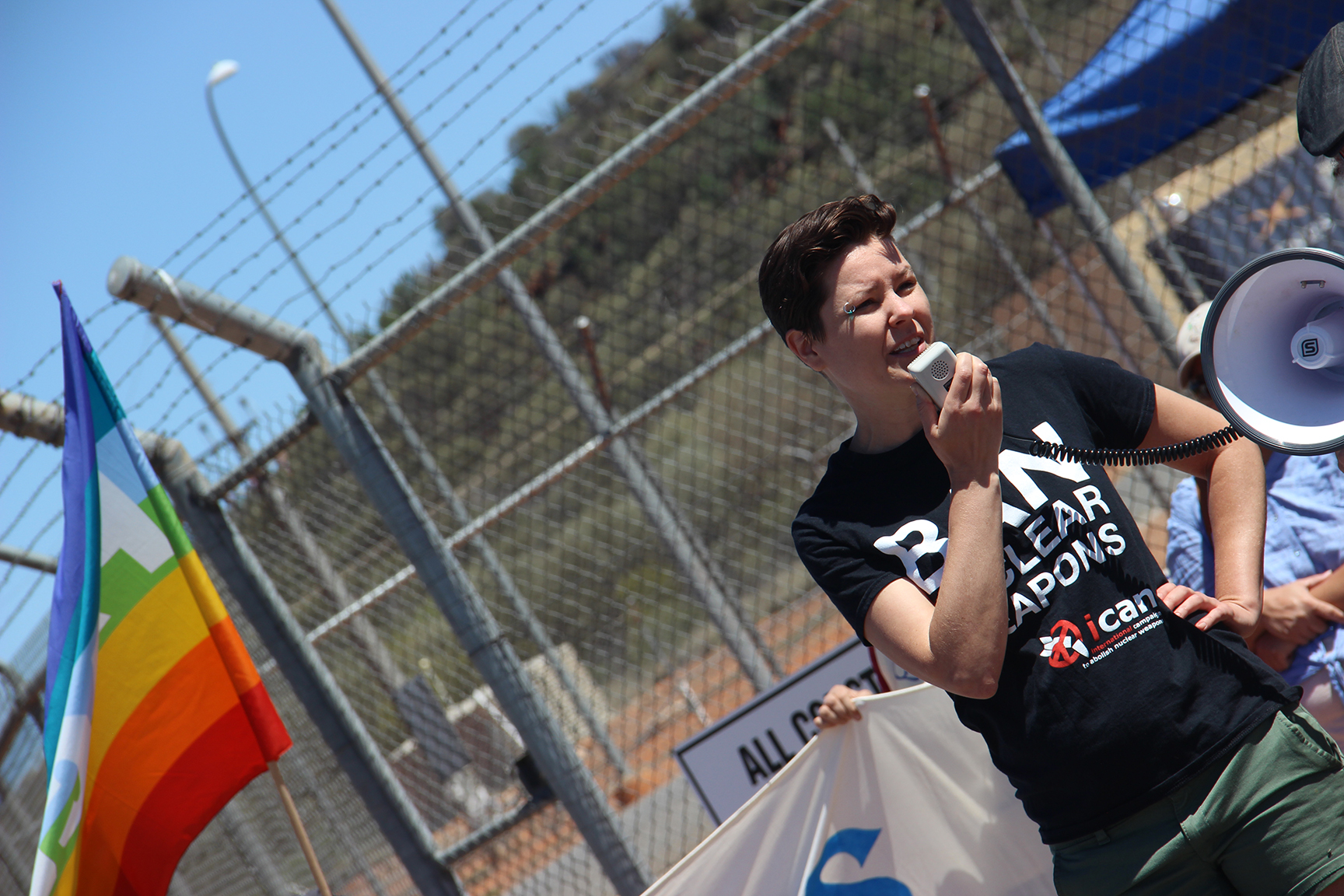 Ahead of the actions and conference at Pine Gap, Ray also engaged with ICAN and WILPF initiatives around the country, briefing members of parliament, civil society groups, and students about nuclear weapons, drones, militarism, and gender. For example she spoke at a the Medical Association for Prevention of War, Victoria Branch Dinner and the Melbourne Free University in Melbourne, a briefing hosted by WILPF Australia and New South Wales Branch in Sydney, and at Parliament in Canberra.
More...
#NoWar2021 Global Conference: From weapons fairs to war zones: Unraveling the war machine
Written by Poorbesh#NoWar2021 is a unique event that brings together a global grassroots coalition of individuals and organizations around the topic of CANSEC and the global arms trade.
At the end of September, peacemakers and anti-war activists from across Australia will be gathering near the red centre of the country to demand the government close the secretive Pine Gap military base, which is a joint facility operated by the United States. It is used to conduct mass surveillance, including as part of the Five Eyes intelligence network; provide data that enables the targeting of US drone strikes; support communications of the US armed forces; and help detect missile launches and target US nuclear weapons. WILPF and ICAN members from Australia, as well as Reaching Critical Will's director, will be joining the nonviolent peace convergence and the Independent and Peace Australia Network (IPAN) National Conference on 1 October.
President of the Fifth Conference of States Parties to the ATT, 26 August 2019, ATT CSP5
Written by PoorbeshNew Agenda Coalition, delivered by Egypt, 21 October 2019, First Committee
Written by Poorbesh